
How To Make a Research Synopsis
Would you want to know how to make a research synopsis? Based on my experience, A thesis summary organises the processes taken to solve the research topic.
A summary should clearly and comprehensively explain why a subject has to be studied using specific practical techniques.
This written work includes a comprehensive literature assessment that proves the suggested study is viable.
However, start by stating your study’s research topic or question. Explain the topic’s importance and relevance, highlighting knowledge gaps or the need for future research.
This establishes your study project and readers’ context.
Determine your research goals. Goals should be explicit, quantifiable, and related to the research topic.
Make sure your major and secondary objectives are doable within your study.
However, I will elaborate further as you continue reading.
Now, let’s get started.
What Is A Synopsis
A synopsis is a condensed description that helps listeners understand the main points of a work. It summarises the plot, style, genre, notable characters, setting, and other elements of the work.
A summary gives the reader an accurate sense of the plot, including key spoilers in fiction. In nonfiction, it describes how the author answers the book’s question.
Synopses vary in intricacy depending on their function.
When submitting a book, article, or other work to possible publishers or editors, for example, authors are frequently required to provide a lengthy synopsis.
In such cases, the synopsis will include a full plot overview (including the reveal of the ending), indications of character development, a thorough explanation of theme and tone, and so forth.
This post will focus on daily website and media synopses.
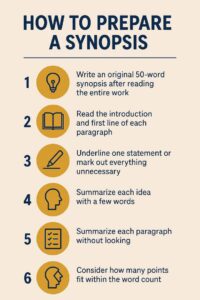
How To Prepare A Synopsis
Effective reading and note-taking techniques that seek to recognise and condense important elements to their essentials are necessary for distilling the main ideas and general story of the original work.
You could attempt a few of the following strategies:
After reading the entire work, without going back and reviewing it, write out your original 50-word synopsis that encapsulates its main ideas.
You can review it to ensure correctness or to see what you missed, but keep your writing to no more than 50 words.
To know more about the overall organisation and important themes of each paragraph, read the introduction and the first line of each paragraph.
For each paragraph, underline one statement that you believe is crucial information to comprehend that part.
Alternatively, mark out everything that isn’t necessary to comprehend the entire piece or paragraph with a marker pen.
Instead of writing down entire phrases, summarise each idea with only a few crucial words.
Without looking, read each paragraph and summarise it in one phrase.
Then, consider how many points you can make in the allotted word count. You may either cut or combine your list of summarised points to meet this word count.
As a rough plan or draft, you could start small by first identifying just keywords or sentences and working your way up to phrases, bullet points, and sentences.
Alternatively, you could begin with the original text and repeatedly summarise each section, paragraph, and sentence until you have reduced it to its most basic form.
Try to stay as far away from the original as you can while creating your initial outline or draft by using your notes or recollection.
You can review it at a later time, but for the purpose of making your own story and feeling secure in the elements you have determined to be crucial, you must first establish some distance.
How to Write A Research Synopsis
The format for your study summary is outlined below. Please take note that the following should only be included once you have prepared your study subject and abstract.
Background: In this section, you should outline the general research in your field of study and then go on to your particular research question.
Talk about the significance of your planned research project to the field of study as a whole.
Also, talk about the scholarly void that your study intends to bridge, which will ultimately lead to your research challenge.
The titles for this section, Theoretical Framework, Methodology, and Conceptual Framework, are not meant to be used interchangeably.
Utilising these methods usually depends on the discipline and the specific subject.
The theory to be used in the object’s investigation is covered in the theoretical framework.
The term methodology refers to the techniques used to collect and analyse data, both quantitative and qualitative.
In contrast, the term conceptual framework describes the main ideas around which the study is focused.
Research questions: These are the ones that will drive the investigation and provide it with greater direction.
Here, you state the hypothesis—the presumption that forms the foundation of the study project.
Be aware that when the investigation is completed, this assumption may turn out to be incorrect.
Study objectives: This outlines the goals of your investigation and the things you hope to accomplish. This, like other things in your summary, needed a lot more clarification.
A review of previous studies conducted in your field is included in the literature.
The purpose is to demonstrate that your study topic is researchable because it has not been studied previously.
Limitations: This section is where you talk about the difficult issues that the study has faced or is anticipated to confront. This would probably inform the research decisions you and your supervisor make, as well as the decision of whether to proceed with the study.
References: Since the research has not yet been completed, this part should include the key works that either inform the body of knowledge that will serve as the foundation for the research or whose conclusions your study seeks to challenge.
These texts are known as “secondary texts” in the arts.
What Is The Format Of The Synopsis
Title of research: Your summary has to specify the subject of your study in detail. This title introduction will make it very evident what kind of study you will be doing.
Page of introduction: An overview of the state of knowledge in your study field as of right now must be included in your introduction.
Literature review: In this section, you must evaluate the findings of other researchers in the subject in which you are interested.
Aim & Objective: What is the purpose of your study, and what do you want to learn? What are the goals you want to achieve with this research project?
Methodology of research: The most crucial section of your synopsis is this one. This section of your study approach has to include the technique you intend to use.
References: When composing your summary, you must include a list of all the sources you used.
Conclusion: A 30-page synopsis and a summary of your PhD study are required for the conclusion section.
What Is An Example Of a Synopsis
Illustration of a Synopsis:
Here is an example of a summary of Jack and Jill’s story:
The tale of Jack and Jill tells of a boy and a girl who ascended a hill together. Sadly, their plan is derailed when Jack stumbles, hurts his head, and tumbles back down the mountain.
They had gone to get a bucket of water. Subsequently, Jill, too, trips and falls, trailing behind Jack.
As you can see, the plot of the narrative is outlined in the summary. Without being too wordy or comprehensive, it presents the key characters and story aspects.
How Do You Present a Research Synopsis
A summary should help the reviewer comprehend the study project quickly. Keep it brief but precise. A synopsis can be formatted as:
Title: Problem statement and hypothesis
- Goals and objectives
- Literature review
- Research methods
- References
- Official needs
Title: The study project title should be concise yet instructive, not spectacular. Small enough and brief. Avoid including the institution name and the number of instances to be researched. The study hypothesis can be included.
Problem statement or hypothesis: The study problem should be clearly stated. Understanding the problem helps the researcher write the proposal.
It also helps build hypotheses. The study should address current issues. Its local or national utility must be described.
The problem’s condition and need for investigation must be stated.
A hypothesis is a speculative prediction or explanation of two or more variables.
The hypothesis should represent the investigator’s knowledge, creativity, and experience, not a guess.
Understanding the situation, studying the literature, and considering other aspects might help build a hypothesis.
A researcher can express the issue and hypothesis in 200 words, including all of the above.
Objectives: All research initiatives should have goals, and they should strive to attain them. Few (2–3) goals are needed.
Must relate to study difficulty. Use “first study” instead of “the only study”.
Literature review: Research projects need literature reviews. It accomplishes:
Introduction to the issue.
It describes local or worldwide work on it or a related topic.
It helps the researcher comprehend others’ problems and their solutions. A literature review helps the researcher anticipate similar or extra challenges throughout the investigation.
After studying the literature, the researcher can structure and modify their methods.
Reviewing study variables helps discover and define their relationship.
Synopses of literature assist reviewers in evaluating researchers’ knowledge. The reviewer evaluates the researcher’s work and study feasibility.
Summary literature reviews should be a manageable amount of detail.
The necessary material should be addressed in 300 words with 8-10 credible, easily accessible sources.
Methods for scientific literature review exist. These include national and international publications, WHO, CDC, and ICMR bulletins, books, Medline and Medlar searches, and researcher conversations.
The Internet is a massive information source. Take care to get only essential data. In the information age, literary reviews are “just a click away.”
Research methods Synopses should include 150–200 words about the study process. Research technique underpins the project. The methodology should include:
- Design study
- Study places
- Sampling
- Various variables and controls
- Exams or investigations
- Data gathering
- Data analysis
- Ethical clearance
Final Thought
Now that we have established how to make a research synopsis, the goal of a research synopsis is to provide a supervisor with an accurate image of the planned project so that they may identify any overlooked details.
Getting permission to do the study itself is much easier with a well-written summary in hand.
Although there aren’t set guidelines for producing this kind of report, a supervisor should be able to grasp the planned study from a brief overview.