
What Is The Difference Between Paraphrasing and Summarising
Would you want to know the difference between paraphrasing and summarising? Based on what I know, summarising is summing up a word or passage concisely using key points.
Paraphrasing is translating a whole passage into your own words and responding or expanding upon what was written originally.
In other words, the summarised text is much shorter.
The beauty of summarisation is skimming over the less critical bits and just writing the main points.
By contrast, a paraphrased text can be shorter, longer, or about the same length as the original.
A paraphrased text makes all the same points as the original text, only in a unique way.
Summarised text may skip over multiple less essential points or entire sections of a text.
Paraphrasing is the better choice when every idea in a text is essential. Summarising is better when the main idea of a text is sufficient.
What follows is an explanation of the distinction between summarising and Paraphrasing.
Why and how to utilise them, Paraphrasing and summarising examples, and instructions on how to do so without plagiarising are provided.
Now, let us get started.
What is Paraphrasing
Paraphrasing is the act of rewording a speech or writing into your own words. After reading or listening to the paragraph aloud, consider the meaning of each sentence and restate it in your own words.
You may simplify, clarify, and make concepts more effective or more relevant to your audience by using Paraphrasing.
Ultimately, the language you have paraphrased may be much shorter, much longer, or roughly the same length as the original, with the same content expressed in a completely different way.
You may effectively communicate the main points of your source without having to quote long text or speech sections or risk being accused of plagiarism by summarising it.
There are several situations in which Paraphrasing could be useful:
When using someone else’s words or writing is required.
When a writer’s ideas outweigh the substance of their work (as in the case of poetry vs an academic dissertation),
You think that a person’s work or speech needs to be simplified for accessibility, space, or other factors.
How to Paraphrase
There are two easy methods to paraphrase. These methods are:
Manual Paraphrasing entails completely reworking the text.
It entails reading the source material several times, comprehending its meaning, and then attempting to preserve the same context while rewriting it in your own words.
One advantage is that complete control over the material is retained. Ensuring the preservation of context and producing an original work of writing are both attainable goals.
Cons: The procedure takes a lot of time and calls for solid writing abilities.
Tool-assisted paraphrasing is the process of rewriting using an online paraphrasing tool. These techniques make numerous contextually accurate clones of a work using artificial intelligence.
Pros: It just takes a few minutes to have the paraphrased information ready. It usually takes little work, and the outcome is satisfactory.
There might not be much need for proofreading. How long it takes is determined by the quality of the tool’s output.
Cons: You have no control over how events ultimately transpire. The tool might not work as planned, which could lead to a poor quality paraphrase.
Verify that the tool you use is capable of more than just word replacement with synonyms.
What Is Summarising
Writing down a text’s or speech’s essential concept is the essence of summarising.
Focus on summarising the key idea(s) of the source material in your own words rather than going line by line.
(Recall the instance when you told your buddies a story. Focus on the highlights!
Summarising is made more accessible since you do not have to meticulously “translate” the text into your own words, line by line.
The drawback is that, compared to a paraphrased text, your summary will not be as thorough and helpful. Additionally, a summary is far shorter than the original.
There are several circumstances when you would wish to provide a summary:
- When a text’s key concepts should be the only ones employed
- When a work’s synopsis alone suffices
- When writing, it must be condensed for readability or brevity
How to Summarise
There are typically two primary forms of summarising:
Manual summarising entails distilling a piece of writing without using any digital tools. It depends only on how good the writer is.
Understanding the original material is essential for manual summarisation.
In order to manually summarise, you need to consider the original draft’s concept before coming up with your condensed version.
Simplify each area of the work and highlight the most essential ideas.
Use language that is simple enough for everyone to grasp.
Benefits: The voice and individuality of the writer may be maintained.
Cons: It takes a lot of time, and you can forget some important information.
Digital summarising is the practice of taking advantage of an online summarizer.
These artificial intelligence (AI) techniques are good at identifying a topic‘s main ideas.
It only takes a few seconds to obtain your desired summary when you use this strategy.
You may also get several summary percentages using the tools.
Depending on the chosen method, they are able to summarise between 10% and 50% of the information.
Pros: With only a few clicks, you can quickly summarise anything.
Cons: Because these technologies are still in their early phases of development, the summary material may need to be revised.
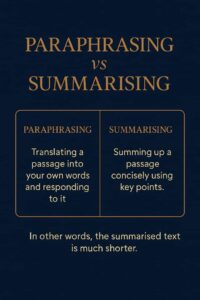
Paraphrasing vs Summarising
Restating someone else’s views in your own words at a nearly equivalent degree of detail is known as Paraphrasing.
Condensing the key concepts from someone else’s work into a more digestible manner is known as summarising.
Adding sources to your writing may be done mostly by paraphrasing, summarising, and quoting.
When choosing which to use, give your writing and your discipline first priority.
For instance, summaries are nearly always included in literature reviews for scientific publications. Contrarily, argumentative essays make use of all three resources.
In argumentative papers, paraphrases and summaries are essential tools since they let you include other people’s views without overcrowding your paragraphs with quotes.
These tips can help you organise your essay more effectively.
Consider using either approach if an idea from one of your sources is important to your essay, but the language has to be.
Your choice may be influenced by space restrictions.
Above all, consider the extent to which the information in the source is pertinent to your position.
Summarise if your viewer needs the most basic information.
Do not refrain from relying too much on paraphrases and summaries, even if they are frequently preferable to quotations. Your opinions are significant. Give yourself time to go through those concepts.
What Are The Similarities Between Paraphrasing and Summarising
The following list highlights the many parallels between summarising and paraphrasing: both techniques enable a person to demonstrate their comprehension of material and interpret it in light of their background and perspective.
Summarising and Paraphrasing are two of the most influential and original strategies to avoid plagiarism.
Time can be saved by summarising and Paraphrasing.
Summarising and Paraphrasing are accepted strategies for assisting with source borrowing.
Both summarising and Paraphrasing convey the content of a text authored by another person using their own words.
Both summarising and paraphrasing aid in making the point clear in a way that is appropriate for the target audience.
When paraphrasing or summarising, the source must be properly referenced in the text using the relevant formatting style (MLA, APA, etc.).
The reference list has to provide information about the source as well.
- Both summarising and paraphrasing help readers understand the content better by putting it in everyday language.
- Summarising and Paraphrasing are both crucial writing strategies.
- Summarising and Paraphrasing give your writing legitimacy.
- Brief quotes can be used in both summarising and Paraphrasing.
The original passage’s meaning remains unchanged, whether paraphrasing or summarising it.
Both summarising and Paraphrasing highlight particular details that you wish to focus on.
Final Thought
Now that we have established the difference between Paraphrasing and summarising, we can see that these tasks differ in duration. Paraphrases are generally as lengthy as the original. However, summaries are always shorter.
Knowing the main differences and similarities between Paraphrasing and summarising can help you choose one for a given occasion.
Paraphrasing and summarising differences are based on the use of distinct terms to summarise a text.
Paraphrasing presents all the information in the original text using other terms without changing the meaning, whereas summarising focuses mainly on the critical concepts and main themes.
Thus, summaries are shorter than the original texts.