
What are footnotes
Would you want to know what footnotes are? From what I have seen, footnotes are notes that are put at the bottom of the page in a scholarly paper and are marked with numbers (or letters or other symbols) above the text. In Word or Google Docs, comments can be added immediately. They are used to giving:
- How to cite sources in a certain way
- Extra knowledge that would make reading the main text harder
- When reading a book or story, have you ever seen that some lines end with a small number?
These numbers generally show up as subscripts and match up with numbers at the bottom of the page.
There is more information next to these numbers that is both important and helpful.
This information will sometimes be in the form of quotes, and other times, it will just be extra notes about the subject at hand.
These lists of sources and descriptions are called “footnotes” because they are at the bottom of the page.
That is not all, however. As you read on, I will teach you more about the subject.
Now, let us get started.
What are footnotes
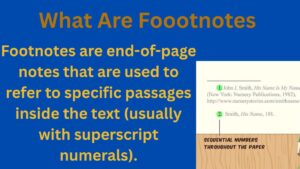
Footnotes are end-of-page notes that are used to refer to specific passages inside the text (usually with superscript numerals).
Writers use footnotes for a variety of things, such as background information, citations, parenthetical information, outside sources, and copyright clearances.
A horizontal line separates the footnotes—a sort of citation or supplemental material—from the body of the text at the bottom of the page.
Students use them to add further explanations, comments, or citations in their academic work.
You could also find it helpful to share your viewpoint while contributing to a piece of information; make sure it improves the work.
To offer clarification, further details, or viewpoints on subjects linked to the main text’s substance, go to the footnotes.
They must be used with in-text citations and a separate reference list when crediting sources or containing references.
What is a footnote example?
One of two types of footnotes—content footnotes or copyright permission footnotes—may be used, depending on the purpose of the note.
Both kinds of footnotes are used in writing manuals published by the American Psychological Association (APA), the Modern Language Association (MLA), and the Chicago Manual of Style (CMOS).
Some further details on these two kinds of footnotes are provided below:
Footnotes on content: These endnotes—also referred to as bibliographical citations—offer more details on the concepts and subjects you address in the body of your work.
Footnotes about copyright permission: These footnotes identify quotes or content that you are using with permission from a publisher or other source.
If you are copying text that is covered by a copyright, you must provide this form of footnote.
Here are the Guidelines for Writing Footnotes
To ensure consistency and clarity, creating footnotes requires adhering to a set structure. A simple structure for creating footnotes is as follows:
Put the Superscript Number here: Place a superscript number or symbol inside the text body after a relevant sentence, paragraph, or phrase that requires a footnote reference.
Write the Footnote Text: At the bottom of the page, write the pertinent footnote text underneath the main text.
This may contain citations, additional information, explanations, and comments on the cited material.
Organise the Footnote: Apply the appropriate citation style guide to format the content of the footnotes (Chicago, MHRA, Oxford, etc.).
Verify that the formatting complies with the specific guidelines and standards listed in the style guide you have chosen.
When to use footnotes
In many situations, a footnote may be helpful, especially when writing formal documents or taking notes at work.
During a team meeting, for example, if the speaker goes over a topic they have already addressed and someone is taking detailed notes, they may add to their earlier notes on that particular problem by adding a footnote and keeping their later notes formatted.
Footnotes are also often employed in research-based professions, where authors of journal articles and research papers usually need to credit data from previously published works.
Depending on the intended function of the footnote, one of two footnote types may be employed.
The following details pertain to the two common types of footnotes:
References in scholarly works: These footnotes list the sources of the data that were used in the written text.
Journal articles, research papers, and educational or instructional materials usually contain them.
Content notes: Content footnotes provide more details on a subject or idea covered in a literary work.
Professionals can utilise these in written messages to staff members or customers, meeting notes, and informational publications or booklets.
However, in practice, footnotes are limited to specific styles; there are regulations specific to each style format.
We will talk about the different kinds of footnotes and how they are handled.
Styles of citation:
- APA format
- MLA format
- Chicago Fashion
Both the Oxford System and the Harvard System
What is the Importance of Using Footnotes
Writers can utilise endnotes and footnotes as tools to help them prevent plagiarism.
The act of writers passing off the concepts or findings of other writers as their own is known as plagiarism.
Plagiarism may seriously damage a writer’s reputation and career. Thus, it must be avoided at all costs.
Using the footnotes and endnotes, readers may also go deeper into information sources to suit their needs.
Generally speaking, one tool employed to guarantee impartial and polite discussion in printed media is the footnote.
The primary aim of footnotes is to reference the source material in a way that preserves the text’s structure by using symbols.
As we previously said, this is done to avoid ruining the organisation of your work by acknowledging sources inside the text when you click on the symbol at the conclusion of the sentence, which takes you to the specifics of the material obtained.
To properly use footnotes, you must be aware of these two objectives:
- To provide further information about the available resources.
- To cite material or data from external sources.
Why do authors use footnotes?
Your work may be simpler for people to comprehend and derive value from if you include footnotes.
They also help to improve the look and structure of the document and to streamline the content.
Some justifications for including footnotes in your work are as follows:
- Make use of footnotes rather than overdoing the annotations, explanations, or observations.
- If the reader follows these notes, they will provide relevant and useful information.
Through the mitigation of diversions, footnotes afford the reader the autonomy to discern the subjects they desire to delve deeper into or validate further.
Writers can adhere to a word count constraint by reducing the word count of their text with the use of footnotes.
The bibliography and the footnote almost have the same material. However, using a footnote has a narrower focus and includes the following:
- Author, Title of the piece of writing
- Location of publishing, Publishers, Date of publication, and
The page (you have to mention the page number where you found the information, if it is a book).
Final thought
Now that we have established what footnotes are, we can also see that footnotes are used similarly. In contrast, endnotes appear at the end of the text rather than on each page.
This declutters your text but might need to be more convenient for readers.
Hence, to improve your writing and reduce page clutter, use footnotes sparingly and solely for valuable additions or references.
As said, this material may be supplemental, so position it apart from the primary part of your article.
When writing footnotes, keep the reader’s convenience in mind and remember that they provide useful information.
If you include too many or unnecessary footnotes, readers could become irritated and lose interest in your text.
Footnotes may improve your writing if you understand “What are footnotes?” and how to use them in accordance with style guidelines.
Refer to your preferred style guide and the previously specified requirements when using footnotes.
See our academic papers if you want assistance with writing!