
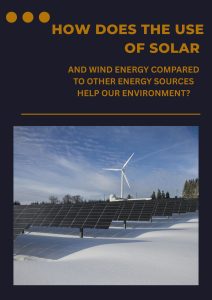
HOW DOES THE USE OF SOLAR AND WIND ENERGY COMPARED TO OTHER ENERGY SOURCES HELP OUR ENVIRONMENT?
The outgrowth in sales of wind turbines and solar panels is becoming alarming, the extra layer of convenience attached to it attributes much testament to its relevance, but that alone doesn’t necessarily solicit for its increase and its general cost (low or high) doesn’t, on the surface, define its benefit over other sources of energies.
Human-wise, it may seem like a positive thrust to the future and a win for comfort, but how does eliciting the use of solar and wind energy impact our immediate environment?
This article explores the many positive impacts of renewable energies, ranging from wind to solar, on our environment.
It is no news that there is an obvious outburst of carbon footprints causing a rise in the human population, the overwhelming habitats on earth have gradually become a vivid cause for concern, and with time, it would become feasible to grow and outstrip our natural resources.
From burning coals to occasioning the use of solar energy, perhaps, a demanding appeal to adhere to; a leap of faith with more human expectation, because at the end of the day, we might eventually outstrip our planet.
Reduces Global Warming
The heightened level of human activities flourishing has led to an overload of carbon dioxide and methane in our atmosphere, the presence of these gases risks trapping heat and ultimately triggers a chain of harmful events ranging from droughts, to storms, to a rise in sea levels, to the eventual extinction of all life forms.
The idea that constant emissions from fossil fuels and natural gases aren’t major contributors to the subsidence of our planet is not nearly true enough. Greenhouse gases and carbon emissions facilitated by various conduits have become large enablers of global warming.
A rising figure of 29 per cent of global warming emissions comes from fossil fuels and natural gases. As opposed to the causal effects of natural gases, solar energies and their range of sources are not associated with the emission of all-encompassing gases.
The use of solar devices to produce energy on a large scale has reduced the risk of carbon emission, which burning natural gases releases a range of 0.6—2 pounds of C02E/kWh, while burning coal emits 1.4—3.6 pounds of C02E/kWh. Using wind turbines, the emission of carbon into the atmosphere in totality is 0.4 percent.
This further demonstrates that the increase in the supply and usage of renewable energy would permit the reduction of carbon-intensive energy sources, further eradicating the spike in global warming emissions.
Thorough research augmented by the National Renewable Energy Laboratory, hinging on its groundbreaking resolve, discovered the possibility of generating electricity for an extensive community with 80 per cent free carbon emissions from renewable resources. This way, they recognised that the electricity sector can become more efficient while causing little damage to the atmosphere using solar and wind energy.
Advances in Public Health
Production of energy via coal and natural gas has been linked to a plethora of health hazards; for one, coal and gas plants are precursors of air and water pollution. They have, over the decade, engendered the growth of nasal blockage, heart attacks, cancers, and neurological damage amongst the principal inhabitants.
Likewise, drilling natural gas and mining coal essentially pose a competing factor on our agriculture and water. The assembly of thermal power plants (both the ones powered by oil, gas, and coal) requires a lot of water for cooling, while power plants withdraw water, the emission of harmful gases into the atmosphere becomes viable, the disruption of the riverine ecosystem is, however, sustained, and the leveled risk of drought may intensify while crop production and animal rearing plummet.
The use of solar and wind energy does not come along with health implications; at most, it helps mitigate the proliferating presence of health complications caused by burning fossil fuels.
Unlike gas plants and coal, solar panels generate electricity without emitting residual elements; they directly mitigate the rising rate of land, air, and water pollution, as such panels are wired to receive sunlight from infinity and engineer the seamless process of energy conversion without dispelling waste.
By their non-affiliation to consumable elements, wind and solar energy preserve the environment as they do not require water to function. Though the wind is essential for a wind turbine, the conversion of wind to energy doesn’t facilitate the pollution of the air.
Provides Stabilised Energy
Power grids are responsible for the circulation of electricity; from time to time, the integrity of these grids becomes susceptible to collapse due to low maintenance, cascaded overloads of electricity, and transmitted and uncontrollable climate change.
Nigeria’s electricity generation mix is a composite of gas-pooled cycle plants and large hydropower plants. When the transmission isn’t made by gas, the entire power plant is diversified to improve efficiency; where there is a heavy absence of gas, the use of hydropower becomes feasible.
Between February and March 2022, the dry atmosphere was only a result of the low rainfall, which made it difficult to generate power for circulation as the water was low, and fuel was subsidised. The production of power became crippling resulting in the collapse of the grid. This led to a 2.86 per cent decrease in GDP
The supply and demand chain of energy possesses a powerful influence over every ecosystem, most especially the ones inclined toward production and consumption. The provision of wind turbines and the use of solar panels would not only complement the strong winds and sunny skies that characterise every season, but it would also render constant, replenished, reliable, stabilised energy.
Solar energy, unlike gas and fossils, is not influenced by climate change, and the supply and consumption of energy can still operate under conditions that would usually demand the shutdown of power plants.
Wind and solar energy are likewise not susceptible to mass implosion as there is a vast shedding of modular components: a composite of numerous wind turbines working relatively so that if hostile weather conditions compromise one, the rest function unscathed, producing uninterrupted power.
Conclusion
Wind and solar energy are important to the environment because they reduce environmental impacts and climate change effects, and also promote economic benefits and job opportunities.
Solar energy, unlike gas and fossils, is not influenced by climate change. The supply and consumption of energy can still operate under conditions that would usually demand the shutdown of power plants.
What are your thoughts on this? Feel free to drop your comments and questions in the comments section.
Discover more from Professional Content Writing Services | Writers King LTD
Subscribe to get the latest posts sent to your email.