
Measurement Tools For Research
Would you want to know the measurement tools for research? Measurement tools are things that researchers and practitioners use to help them test or evaluate subjects, clients, or patients.
The tools are utilised to record or quantify a wide range of factors, encompassing everything from physical functionality to mental health.
Scales, indices, polls, interviews, and casual observations are all types of measuring tools.
If you keep reading, this guide will do more than just that. It will walk you through the process of finding measurement tools and more.
Now, let’s get started.
What Are Measurement Tools
Researchers and practitioners use measurement tools to help them look at different aspects of their patients, clients, or topics.
The factors can include anything from how well your body works to your mental and social health. The instruments are also made in different ways.
They could be an official assessment or a casual note asked of someone.
There are many ways to measure something, such as through surveys, questionnaires, interviews, bodily measures (like heart rate and blood pressure), behavioural observations, and performance tests.
It is very important to pick the right measuring tool to make sure that the data you collect is true and accurate.
The level to which a measuring tool measures what it’s supposed to measure is known as its legitimacy.
Dependability, on the other hand, means the stability and consistency of the measurement tool over time and in different settings.
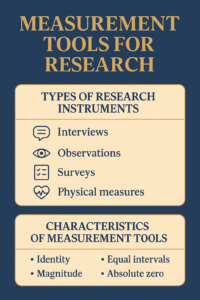
What Are The Types of Research Instruments
1. Interviews, or conversations in which an interviewer asks an interviewee a question in order to get a verbal answer.
A structured interview is one in which each interviewee is given a formal set of questions to answer and is recorded following a specified protocol.
Unstructured Interview: A less formal series of inquiries, with the interviewer adjusting the questions’ order and phrasing.
Non-Directive Interview: An unstructured interview that makes use of impromptu interaction and open-ended inquiries.
Focus Interview: An approach in which the interviewer engages the subject to extract further information, with a focus on the subject’s subjective and personal reactions.
Focus Group Interview: A group of chosen participants is questioned about their thoughts or impressions on a specific subject.
Observations. One kind of correlational (non-experimental) tool that researchers use to monitor individuals in action is observation, or observing what they do.
Structured Observations: Studies carried out at a set location and time during which subjects are watched according to a predetermined protocol.
Researchers classify observed actions based on a predetermined scale rather than providing a thorough account of every activity they see.
Naturalistic observation: the examination of individuals’ impromptu actions in their natural environments. All the researchers do is write down what they observe.
However, they interpret it.
Participant observation is a form of natural observation where the researcher immerses themselves in the group being studied to obtain a deeper comprehension of their lifestyle.
What Are The Steps To Finding Measurement Tools For Research
Ascertain your requirements:
- Are you looking for exams that focus on a certain subject or assess a certain variable?
- Which would you prefer—a test or a test manual?
- Do you have to understand how to utilise an exam?
- Are you looking for information on where to buy or borrow an exam?
- Would you like an exam in particular reviewed?
- Would you want to create your exam?
- Decide on whatever variable you wish to assess:
- Which vocabulary defines the variable?
- Is it too wide or too confined?
- Is it quantifiable?
Using the following criteria, find a few tests that could be suitable for your requirements:
- Is the variable you wish to evaluate measured by the test?
- Are you certified to take this exam?
- Which age range or academic grade level is the exam intended for?
- Does it have positive reviews? In what number? Where?
- Are there any guidelines available for giving the test?
- How hard is it to get hold of a copy? What is the price?
Why Are Measurement Tools Important In Research
Tools for measurement are generally considered vital in research because they make it possible to gather quantitative data that can be evaluated and statistically analysed.
These instruments guarantee the validity, accuracy, and reliability of the data collected, essential for deriving significant inferences and making defensible choices in light of the results. These instruments are crucial to study for other reasons, which are as follows:
It guarantees consistency in research: Measurement consistency is important for research because it lowers data variability, which can enhance the validity and dependability of the findings.
In order to ensure that future researchers can repeat the results, measurement tools make sure that data is collected consistently across various individuals, locations, and timeframes.
It guarantees research validity, which is defined as the extent to which an instrument or measure properly represents the construct or idea that it is meant to measure in this context and research.
Stated differently, the validity of a measuring instrument is its ability to measure the things it is supposed to assess. Validity is a critical component of research measuring instruments.
There are various causes for this.
How To Identify Measurement Tools For Research
First of all, the study’s findings will be untrustworthy, and any conclusions reached will be false if the measuring tool is not legitimate.
Second, because researchers could spend time examining data that does not measure what they meant to test, a lack of validity can be a waste of time, money, and effort.
Ultimately, validity is essential to guaranteeing that the results of a study may be applied to the population under investigation.
It is only possible to presume that study results are representative of the population if a measurement tool is fixed.
It guarantees research dependability: Repetitive use of a measuring tool or equipment yields consistent findings, demonstrating the dependability of the data gathered.
Depending on the kind of measuring instrument being used, reliability may be evaluated in a variety of ways.
Reliability may be evaluated, for instance, if a questionnaire is used to gather data and it is given to the same set of individuals twice, with different results.
If the findings are consistent across the two administrations of the questionnaire, then it is very dependable.
This is beneficial since academic research and the field as a whole depend heavily on reliability.
It encourages standardisation: In research, standardisation is the process of making sure that every part of the study is regulated and uniform in order to lessen the likelihood of bias or variability.
This involves standardised research processes, including participant instructions, test or measure administration, and data collection techniques.
Research is standardised and enforced with the use of measuring instruments, which ensures validity and reduces the possibility of bias.
What Are The Characteristics of Measurement Tools For Research
Identity: The definition of identity is the numerical values assigned to each variable in a data collection.
Take into consideration, for example, a questionnaire that asks for the respondent’s gender and provides the choice of male or female. Males and females can be assigned the values 1 and 2, respectively.
As these values are only for identification, arithmetic operations cannot be done on them. This is a nominal scale feature.
Magnitude: The size of a measuring scale, where the identity (numbers) have a natural order from lowest to highest, is known as the magnitude.
Usually, they are shown in either ascending or descending order on the scale. For instance, in a race, the positions are assigned from the least to the first, second, and third.
Because this example has both identity and magnitude, it is assessed using an ordinal scale.
Equal intervals: A scale with a consistent sequence is referred to as an equal interval. That is, there is a constant difference between every level on the scale.
For the above-highlighted example of an ordinal scale, this is not the case.
There is no constant interval difference for every location. A race can be finished in 20 seconds by the first-place finisher, 20.8 seconds by the second-place finisher, and 30 seconds by the third-place finisher.
An interval scale is used to measure a variable that has identity, magnitude, and equal intervals.
Absolute zero: A ratio scale’s distinctive feature is known as absolute zero.
It is defined as the lack of the variable being assessed (e.g., no money, no qualification, no gender identity, etc.), and it indicates that there is a zero on the scale.
Final Thought
Now that we have established Measurement tools for research, it might take some effort to find measurement tools that have undergone validation and evaluation.
If you are certain of the tool’s name, you may hunt for reviews and validation by searching the literature.
If you are searching by topic, you can try to find scales and measurements that have been used in the past by performing basic literature searches in CINAHL and PubMed.