
CITATION – THE DIFFERENT CITATION STYLES AND WHY YOU SHOULD CITE YOUR SOURCES
The field you’re writing in will have a major impact on the citation style you use. Many teachers prefer or even demand a specific writing mode when assigning homework. Check with your professor or, if you are submitting a manuscript, the publisher, to see if they have a preferred style if you are unsure.
As long as you stick to one style throughout your work, you may not need to worry about whether or not you’re following any rules. If you are free to make a choice, this chart should be helpful. When documenting your sources, you must adhere to a specific citation style, which is a predetermined set of rules and conventions.
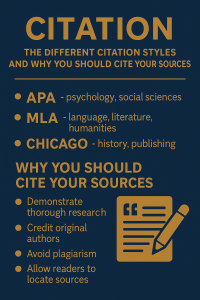
The Modern Language Association (MLA), the Chicago Manual of Style, and the American Psychological Association (APA) are a few examples of organisations that define citation formats and styles. Which citation style you use depends on your field of study and on who will be reading or publishing your work. We will discuss extensively with examples the commonly used citation styles (APA, MLA, and Chicago Manual of Style), when to and how you can use them.
APA, AMERICAN PSYCHOLOGICAL ASSOCIATION
The American Psychological Association’s (APA) guidelines for written expression are based on how to format a manuscript for publication in a specific field, including guidelines for content organisation, writing style, referencing, and more.
Using APA Style not only streamlines the editorial process by requiring a consistent format across all submissions to a publication, but it also facilitates readability by providing a framework that readers are already familiar with, because of its usefulness in so many fields of study, APA is frequently chosen as the single documentation style to be used across the board at universities.
Some online schools insist that their students use the APA format for citations. Also, the APA format contains several editions, and the most recent edition is the APA 7th edition, which is another thing to consider when choosing APA formatting style for your academic work.
The American Psychological Association (APA) recommends the APA style for papers in the behavioural and social sciences. These include fields like psychology, sociology, history, and communication. It’s also a staple in MBA programs.
For APA citation format, In-text citations in APA style should use the author-date system. This necessitates the inclusion of details such as the surname of the author and the year the source was published within the text, such as (Adams, 2019).
The reference list at the end of the paper should include one full citation for each source used. You only need to include the author and year of publication, not the page number, if you are referring to an idea from another work without directly quoting the material or referencing an entire book or article.
If you are directly quoting or paraphrasing from another source, add the page number to the end of the parenthetical citation. It is customary to abbreviate page numbers as “p.” for a single page and “pp.” for multiple pages. Referring to a range of pages? Use an en dash. When referencing, Adams P. (2019) [the title of the book, journal, thesis], then the page number [ p.12, pp. 12–24].
The referencing for APA format varies depending on the edition in use and the source type, such as books, thesis, journal, website, movie or online content. All sources cited in the text must be included in the reference list at the end of the paper, regardless of the referencing style used. Please note that in your References list, you should only capitalise the first word of each title.
MLA (Modern Language Association)
There are a few variations when it comes to MLA citation style, even though MLA is similar to APA in some ways. The majority of humanities disciplines adopt MLA as their standard citation method, Parenthetical citations in MLA format require both the author’s surname and the page number, as MLA was designed for referencing printed works such as books, anthologies, and literary works in which the author’s name and location within the work are crucial.
Include only the author’s surname and the page number in an MLA in-text citation; the year of publication is not necessary, for example, in the case of just one author, an in-text citation for MLA will appear thus, (Jerry, 34), when there are three or more authors, the first name is listed, then “et al.” is added in either format for example, (Jerry et al. 34).
Both the Modern Language Association (MLA) and the American Psychological Association (APA) require that you include a separate page at the end of your paper to list all of the information about the sources you used. These citations are referred to as the References in the American Psychological Association (APA) format and Works Cited in MLA.
CHICAGO MANUAL OF STYLE
For writers in the humanities, the Chicago Notes and Bibliography (NB) system is a go-to for properly crediting their sources in the form of footnotes, endnotes, and a bibliography.
This provides writers with a plethora of options for referencing and a forum for discussing those references. If you want to establish your authority as a writer, you need to show that you’ve done your research and are willing to take responsibility for what you write.
The Chicago Manual of Style is a comprehensive style guide for editors. Its wide-ranging coverage includes everything from manuscript preparation and publication to grammar, usage, and documentation. Two different citation formats are explained in detail in the Chicago Manual of Style: author-date and notes and bibliography.
Footnotes and endnotes are used to cite sources in the notes and bibliography format, which is commonly employed in the humanities.
Brief in-text citations are included in the text in the author-date style (typically used in the sciences).
Both styles employ an alphabetised bibliography or reference list that includes complete citations for all used sources. Pay close attention to the punctuation of your notes and citations (such as commas, parentheses, and quotation marks).
Why Should You Cite Your Sources?
There are several reasons why you should properly credit the resources you used for your research:
- By citing your sources, you demonstrate to the reader that you have conducted a thorough investigation of the topic at hand.
- To act as a conscientious academic, one must properly attribute one’s sources and acknowledge the work of others.
- To stay away from the plagiarism trap of quoting other authors’ work entirely
- Provide a way for the reader to locate the sources you consulted by properly citing them in your paper through either footnote, a bibliography, or a reference list.
Conclusion
Now that you know about citations, the different citation styles, and why you should cite your sources, it is important to note that citation in any work gives reference and credit to the original owners of a work that was used in carrying out a particular research or study.
When you cite people’s works, it helps to prevent plagiarism. It makes your work more original.
Discover more from Professional Content Writing Services | Writers King LTD
Subscribe to get the latest posts sent to your email.