
HEALTH NEEDS ASSESSMENT IN PRACTICE
Table of Contents
2. Social and Health Care Data in Essex 4
3. Determinants Inequalities and Barriers to Health in Essex 13
4 Critique of the Health Care Services Available for Dementia 15
4.1 Health Care Services Available for Dementia 15
1. Introduction
This paper focuses on the rising health risk in the Essex region. From the surveyed data in the area, there is a clear indication of the increasing need for public health services in dementia therapy.
Before delving into the critical component of this report, this research first presents an introduction to Essex, which covers the county’s demographics along with the specific local health and social services in Essex to determine why Dementia, which has been classified as the most urgent concern for the area, is on the increase.
The report will move forward to offer more details regarding the locality of Essex in the second section.
This includes all the many medical services in the region to clarify the frequency of Dementia in Essex and its epidemiology. This information is supported by graphs, tables, and real-time data to provide a comprehensive picture of the public health issue the region faces.
The information and figures in this report section were gathered from the National Health Service (NHS) and the official local authorities in Essex. The factors responsible for inequalities, marginalisation, and barriers to health in Essex are extensively analysed in the third section of the research. It is crucial to note that this analysis is, however, restricted to Essex’s current dementia epidemic.
Thus, this section will compare the factors affecting health in Essex and the rest of the United Kingdom using empirical data. The fourth section presents an analysis of the current service provision in Essex.
This section specifically focuses on the policies that affect service delivery and discusses nurses’ roles in Essex’s health screening and promotion. It is followed by the Conclusion, which summarises the most significant findings from the study and offers recommendations for future practices.
2. Social and Health Care Data in Essex
2.1 Social Data
Essex, a County in the United Kingdom, is situated northeast of London and southeast of England.
According to data acquired during 2015–2017, it is noteworthy that the life expectancy at birth is around 83.3% for girls and 80.2% for males [Public Health Intelligence Research and Insight Essex County Council (PHIR Essex County), 2019]. This is based on the observation that females have a greater life expectancy at birth than males.
The county has a higher life expectancy than England, whose birth expectancy is 79.6 years for men and 83.1 years for women (City Population, 2020). In the Essex region, cancer kills 131 people per 100,000, cardiovascular disease kills 62.6 people per 100,000, and respiratory illnesses kill 30.8 people per 100,000 (PHIR Essex County, 2019).
Table 1. The growth of the population of Essex

Not all districts in Essex have the same population density, which stands as a crucial consideration. Between 2011 and 2018, each district significantly expanded, as shown in the bottom right corner of Image 1 below.
According to PHIR Essex County (2019), Colchester and Basildon are the places in Essex with the largest populations and the fastest population growth rates, while Maldon is the region with the fewest inhabitants. More details on the local demographic changes are provided in the following sections.
Figure 1 shows the population growth rate over an average year.

source: PHIR Essex County (2019)
According to the area’s demographic figures for 2019, Essex has a total female population of 760,839. In contrast, the number of males is projected to reach 728,350 in 2020 (City Population, 2020). This suggests that there is no wide disparity among the population’s members.
Figure 2 makes it abundantly evident that persons between the ages of 18 and 64 make up the majority of the population in the area (City Population, 2020). This shows that Essex’s population’s average age is relatively high and low. Another significant component of this number’s relevance is that it illustrates that a sizable portion of people in Essex are at risk for having Dementia (Mapes & Hine, 2011).
The demographic structure of Essex is further broken down in Figure 3 compared to the population structures of other regions in the United Kingdom. The towns of Castle Point, Maldon, Rochford, and Tendring have the greatest senior populations overall in terms of the percentage of the total population comprised of individuals over 65.
According to statistics from the City Population (2020), the regions of Basildon and Harlow have a lower percentage of older citizens. However, the age distribution in Essex is examined in further detail in Figure 4. From the graph, it is evident that a significant portion of the population in Essex is older than sixty.
Figure 2: Population Structure in Essex

Source: City Population, 2020
Figure 3: The Population’s Age Distribution in Essex

source: PHIR Essex County (2019)
Figure 4: Essex’s Age Distribution

Source: City Population, 2020
The information in the accompanying graph makes it abundantly evident that the great majority of people who now live in Essex were born in the United Kingdom (Figure 5).
Moreover, 1.2 million people in Essex were born in the United Kingdom, 9,278 people were born in the Republic of Ireland, and around 30,000 people were born outside of Europe, according to the City Population from the 2020 projection. In comparison, around 61,000 city inhabitants (City Population, 2020) were born on a continent other than Europe.
This trend supports the Essex population’s ethnic breakdown, which shows that the city has a mostly white population (City Population, 2020). The information in Figure 6 indicates that in 2011, around 1.3 million white people were living in Essex. Contrarily, the region had 34,000 individuals of Asian heritage and over 18,000 people of Black descent, compared to only 2,000 people of Arab descent. Only around three thousand people are in the region when all other populations are considered.
Figure 5: The Country of Origin of a Person

Figure 6: A group of ethnic people from 2011

Source: Alihu (2011)
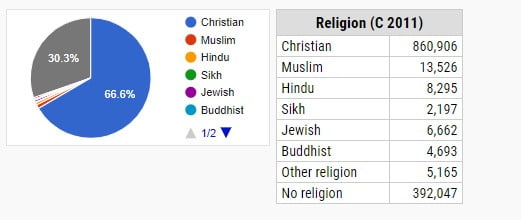
Religious practices are one of the most significant factors that shape a place’s sociocultural composition (City Population, 2020). Religion is important because it significantly affects the cultures that people accept, including what they consider morally suitable and wrong.
It also affects how individuals manage health-related issues, such as deciding who or what needs to go to the doctor and who or what may be treated in the privacy of their own homes. The religious makeup of the region is presented in Figure 7 below.
Figure 7 of Essex’s Population’s Religious Makeup
Source: City Population, 2020
2.2 Health Data of Essex
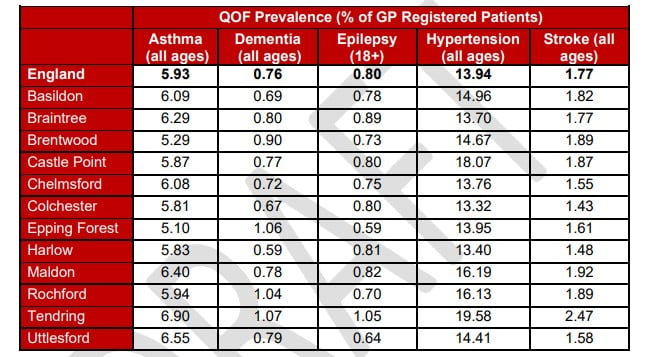
Dementia is one of the illnesses with noticeably higher rates of illness and admissions in Essex, with a predicted increase of more than 1% above the average for England (City Population, 2020). As a result, it is one of the diseases with a high prevalence rate. According to the trends, eight of the twelve Districts have higher rates than England, while only four have lower rates than England (Figure 8).
The overall diagnosis rate for Dementia in Essex rose from 60% to 64.5% between 2017 and 2019. Despite this, the prevalence of dementia diagnoses is still low, indicating that there may be more people in this region who have Dementia but have not yet been diagnosed with it.
Figure 9, however, shows that the issue of Dementia is anticipated to become considerably more common within a relatively short period. The Projecting Older Persons’ Population Information (POPPI) also predicts that by 2019, there will be around 21,972 people in Essex who are over 65 and have Dementia.
The estimates indicate that if everything remains the same, this figure might increase by 33% by 2030, demonstrating why it is such a significant public health concern for Essex.
Figure 8: QOF Prevalence (% of GP Registered Patients)
Source: Older People’s Population Information (POPPI
Figure 9 Projected number of people aged 65+ with Dementia
 Source: Older People’s Population Information (POPPI)
3. Determinants of Inequalities and Barriers to Health in Essex
According to findings from Davies et al. (2018), people in the UK who earn below-average salaries often have worse health and shorter life spans than those who are financially successful. Data from several earlier studies also showed that socioeconomic inequalities cause an increase in morbidity and a decrease in life expectancy in the country.
The study by Moldovan (2018) predicts that inequality would directly cause the loss of an average of 1.3 to 2.5 million years of life each year in the United Kingdom.
Additionally, the Siddiqui et al. (2020) study showed that the population vulnerable to marginalisation is often characterised based on age, gender, disability, marital status, pregnancy, race, ethnicity, belief, religion, or sexual orientation. For instance, only a relatively small percentage of the region’s workforce comprises people of Asian, Black, and Arab descent.
Furthermore, this group faces considerable discrimination when accessing medical treatment and educational services (Living Well Essex, 2020). This information highlights the magnitude of the problem confronting ethnic minorities in the region. This also suggests that there is a good chance that there will be noticeable ethnic inequalities in Essex.
Another notable trend, according to Galama and Kippersluis (2012), is that White males have access to more employment opportunities than persons of any other gender or ethnicity. The key causes of ethnic minorities’ underrepresentation in formal work, according to Galama and Kippersluis (2012), are differences in their countries of origin, ethnicities, and languages, which are connected to the first two criteria.
However, the fact that fewer than 92,000 residents of Essex, as seen in Figure 5, were born in nations or territories that are not a part of the UK invalidates this argument. Instead, Essex experiences systemic prejudice against racial and ethnic minorities, similar to those in other parts of the United Kingdom (Galama and Kippersluis 2012).
It is crucial to note that women from racial and ethnic minorities are exposed to the most marginalisation. This results from the fact that women face greater economic disadvantages than men do, even among the ethnic groupings that make up the majority (Moldovan, 2018).
Furthermore, the problem of Dementia has also affected this population. According to Alzheimer’s Research UK (2020), Alzheimer’s disease, Parkinson’s disease, and Huntington’s disease are a few further prevalent causes of Dementia, while age, genetics, diabetes, depression, smoking, eating poorly, drinking excessively, not exercising, and abusing drugs are a few physical and lifestyle variables that may contribute to the development of the illness.
Linking this Conclusion to the findings of Galama and Kippersluis (2012), which suggest that the marginalised groups in Essex have more health risk behaviours such as drinking excessively, not exercising, and drug abuse, it follows that the marginalised group in the region is more at risk of having Dementia.
The same is true of Essex’s dementia statistics, which show that compared to White populations, who make up the majority, persons of racial or ethnic minorities and members of economically disadvantaged groups are disproportionately affected by Dementia. Around 22,000 Essex residents had Dementia in 2012, according to the Essex County Council.
This population is projected to be about 30,000 by the year 2020 and 35,000 by the year 2035, according to projections from Essex County Council et al. (2012). Creed (2019) predicted that by the year 2050, there would be about 73,000 people living with Dementia, a 156% rise over the statistics for the previous year.
4 Critique of the Health Care Services Available for Dementia
4.1 Health Care Services Available for Dementia
Unfortunately, the services offered to dementia patients in Essex are not as successful as they may be. According to a 2017 NHS report titled “Southend, Essex, and Thurrock Dementia Strategy 2017-2021,” the quality of care offered to dementia patients is poor, inconsistent, and fragmented. Additionally, the number of people with Dementia has generally increased, increasing the demand for caregiving services.
The NHS (2017) report on the quality of services currently available highlights the fact that the majority of services are only intended for those who have been diagnosed with Dementia, even though the UK’s proper strategy is to target and support entire families to meet the needs of caregiving.
Another big issue in Essex is that Dementia is often overlooked in its early stages, which lowers the effectiveness of illness treatment. Essex has a widespread lack of high-quality information and help, both of which are required for the successful planning and treatment of Dementia, according to the NHS (2018).
The 2017 NHS report on racial and ethnic composition also highlighted that Dementia is underdiagnosed among racial and ethnic minorities in Essex, especially Black and Asian Minority Ethnic (BAME). This claim is supported by the figures provided by Darwent (2017), which are summarised in Figure 10.
Despite this, this group has considerably greater rates of Dementia than the general population. Additionally, even members of this group with a dementia diagnosis are less likely to utilise the current dementia services. According to Darwent (2017), Essex has a substantially less general understanding of Dementia and less access to support for those with the disease than the UK.
Additionally, there is a lack of culturally competent providers and an issue with delayed diagnosis in the region. This directly improves the quality of services provided to the White majority population relative to the ethnic minorities that make up the population’s minority (Darwent, 2017).
Figure 10: Recorded Cases versus Unrecorded Dementia Diagnosis

Source: Adapted from Darwent (2017)
According to Essex Dementia Care (2021), the adult social services department in several locations is responsible for overseeing the daily personal care activities of dementia patients. The social services group offers speciality services, including access to day centres, help and modifications, washing and dressing, laundry services, and meals delivered to clients’ homes. (North East Essex Health and Social Care, 2020).
They provide information on local and national services, including charities, to people with Dementia and their families (The Good Care Group, 2020). This is another important feature of their services (The Good Care Group, 2020).
Additionally, they are beneficial in supporting the requirements assessment process. A diagnosis of Alzheimer’s does not automatically make a person eligible for financial assistance for Alzheimer’s services, even if there is no fee for the required assessments. The NHS offers inclusive treatment in hospitals and general practitioners’ offices. For example, physiotherapy, hearing care (also known as audiology), eye testing (also known as optometry), foot care (also known as podiatry), speech and language therapy, and support from the Older People’s Mental Health team are all included in this assistance (NHS Right Care, 2018).
It is crucial to be informed that the National Health Service (NHS) collaborates with the non-profit group Dementia UK to supply Admiral Nurses in certain regions (The Good Care Group, 2020). This kind of treatment entails knowledgeable dementia nurses from the NHS visiting dementia patients in their homes.
4.2 The Nurses’ Role
When it comes to the treatment of Dementia, nurses’ advocacy obligations are crucial, especially in the context of Essex, which is replete with issues with the delivery of care services. Nurses may focus on ensuring that people with Dementia can effectively manage their illnesses despite their conditions and provide professional care services (Wittenberg et al., 2019).
Since they are the ones who give the most care in social settings, particularly in the homes of persons living with Dementia, these services must also include support for relatives of people with Dementia. Moldovan (2018) contends that in these circumstances, families need aid in figuring out the best ways to help their loved ones with Dementia.
Depending on the requirements of the family and the dementia patient, they also need information on where they may get treatment services or other sorts of care, including financial support from charities (Moldovan, 2018). This assistance could take the shape of knowledge.
Nurses must spread more awareness about the value of an early diagnosis and the places where one may be made. Additionally, they must encourage those from low socioeconomic areas and racial/ethnic groups to ask for help when they need dementia care (Moldovan, 2018).
The activities of the nurses are primarily limited to advocating for dementia patients and spreading knowledge of the condition, since, as was previously said, there is little that can be done to ameliorate the symptoms of Dementia once they have begun.
Figure 11: The Nurse’s Role in Managing Dementia

source Living Well Essex, 2020
5 Conclusion
The results of this investigation show that White people make up most of Essex’s population. There have been reports that the region is experiencing significant health problems, but Dementia remains one of the most important health challenges confronting the area.
Dementia patients may not get adequate care from current providers, according to some reports. Despite making up only 5.7% of the total population, research has found that ethnic minorities in Essex suffer from Dementia at a rate that is disproportionately greater than that of the general population.
The results of this investigation show that people of colour are more likely to have several of the major physical and lifestyle variables that cause Dementia. Despite this, the majority of ethnic minorities get preliminary diagnoses.
Additionally, most people with diagnoses do not get treatment or have access to it. This might be partially ascribed to the care services’ need for cultural awareness. It is necessary to improve the accessibility and quality of care services offered to the residents of Essex, especially the populations made up of racial and ethnic minorities and those economically underprivileged.
The best chance for this development is if nurses take on the role of advocates and educate patients and the general public about dementia-related concerns.
References
Alzheimer’s Research UK. (2020, June 25). Diagnoses in the UK. Retrieved from www.dementiastatistics.org: https://www.dementiastatistics.org/statistics/diagnosesin-the-uk/
Byrne, B., Alexander, C., & Shankley, W. (2019). ETHNICITY, RACE AND INEQUALITY IN THE UK: State of the nation. Place of publication not identified: POLICY Press.
City Population. (2020). ESSEX County in the United Kingdom. Retrieved from www.citypopulation.de: http://www.citypopulation.de/en/uk/admin/E10000012__essex/
Creed, R. (2019, October 31). The number of people in Essex diagnosed with Dementia is to reach 73,000 by 2050. Retrieved from www.gazette-news.co.uk: https://www.gazettenews.co.uk/news/18003440.number-people-essex-diagnosed-dementia-reach-73-000-2050/
Darwent, Melissa. (2017). DEMENTIA IN THE EAST OF ENGLAND. London: NHS East of England Clinical Networks. Retrieved from file:///C:/Users/User/Desktop/East%20of%20England%20Dementia%20Infographics%20Final%20Version%20Nov%202017.pdf
Davies, N., Manthorpe, J., Sampson, E. L., Lamahewa, K., Wilcock, J., Mathew, R., & Iliffe, S. (2018). Guiding practitioners through the end-of-life care for people with Dementia: The use of heuristics. PLoS One, 13(11), e0206422.
Essex County Council. (2019). Essex Local Economic Assessment. Essex: Essex County Council.Essex County Council; Southend-on-Sea Borough Council; Thurrock Council; NHS North
Essex Dementia Care. (2021). Essex Dementia Care is here to help. Retrieved from www.essexdementiacare.org.uk: https://www.essexdementiacare.org.uk/
Essex; NHS South Essex; NHS Foundation Trust. (2012). Living well with Dementia: A dementia strategy for Essex, Southend and Thurrock. Retrieved from Southend CCG.nhs.uk: https://southendccg.nhs.uk/about-us/key-documents/128-essexdementia-strategy/file#:~:text=Within%20the%20geographical%20area %20of,increase%20to%2035%2C000%20by%202025.
Galama, T., & Kippersluis, H. v. (2012). A Theory of Socioeconomic Disparities in Health Over the Life Cycle. Rand Working Paper, DOI: https://doi.org/10.7249/WR773.
Living Well Essex. (2020). Living Well Essex ESSEX JOINT HEALTH AND WELLBEING STRATEGY 2018-2022. Retrieved from www.livingwellessex.org: https://www.livingwellessex.org/media/621973/jhws-2018-cabinet-aug-2018.pdf
Mapes, N., & Hine, R. (2011). Research Project: Living with Dementia and Connecting with Nature–looking back and Stepping Forward. Dementia Adventure, Essex.
Moldovan, A.-L. (2018). Socioeconomic disparities in science knowledge, biomedical self-efficacy, and public participation in medical decision-making. PhD thesis, University of Essex, http://repository.essex.ac.uk/id/eprint/21632.
NHS North East Essex. (2020). DEMENTIA. Retrieved from www.neessexccg.nhs.uk: https://www.neessexccg.nhs.uk/dementia-1
NHS Right Care. (2018, December). Equality and Health Inequalities Pack: NHS North East Essex CCG. Retrieved from www.england.nhs.uk: https://www.england.nhs.uk/wpcontent/uploads/2018/12/ehircp-e-north_east_essex-ccg-dec18.pdf
NHS (2017). Southend, Essex and Thurrock Dementia Strategy 2017–2021. London. https://www.livingwellessex.org/media/523329/Dementia-Strategy.pdf: NHS.
NHS. (2018, July 24 ). Dementia, social services and the NHS. Retrieved from www.nhs.uk: https://www.nhs.uk/conditions/dementia/social-services-and-the-nhs/
NHS. (2018, September 18). Dementia and care homes: Dementia guide. Retrieved from www.nhs.uk: https://www.nhs.uk/conditions/dementia/care-homes/
Public Health Intelligence Research and Insight, Essex County Council. (2019, September). Joint strategic needs assessments: Essex Countywide Report. Retrieved from cmis.essex.gov.uk: https://cmis.essex.gov.uk/essexcmis5/Document.ashx?czJKcaeAi5tUFL1DTL2UE4zNRBcoShgo=0j2Cl10xBy8FeoppSl8d6Q4T5vm1Km0AJWzeXTmK%2BjuopxlGt4NY2Q%3D%3D&rUzwRPf%2BZ3zd4E7Ikn8Lyw%3D%3D=pwRE6AGJFLDNlh225F5QMaQWCtPHwdhUfCZ%2FLUQzgA2uL5jNRG4jdQ%3D%3D&mCTIbCubSFfXsD
Siddiqui, T. G., Whitfield, T., Praharaju, S. J., Sadiq, D., Kazmi, H., Ben-Joseph, A., & Walker, Z. (2020). Magnetic resonance imaging in stable mild cognitive impairment, prodromal Alzheimer’s disease, and prodromal Dementia with Lewy bodies. Dementia and Geriatric Cognitive Disorders, 49(6), 583-588.
The Good Care Group. (2020). Dementia charities in the UK. Retrieved from www.thegoodcaregroup.com: https://www.thegoodcaregroup.com/live-incare/dementia-care/dementia-charities-uk/
Wittenberg, R., Hu, B., Barraza-Araiza, L., & Rehill, A. (2019, December). Projections of older people living with Dementia and costs of dementia care in the United Kingdom, 2019–2040. Retrieved from www.lse.ac.uk: https://www.lse.ac.uk/cpec/assets/documents/cpec-working-paper-5.pdf
Discover more from Professional Content Writing Services | Writers King LTD
Subscribe to get the latest posts sent to your email.