
- April 25, 2025
- Posted by: Igbaji Chinwendu
- Category: Project Writing Guide

Definition of Values and Norms
Contents
Would you want to know the definition of values and norms? From my perspective, values—such as privacy, money, or justice—are usually regarded as “what one finds important in life,” for instance.
Usually, norms are those accepted or permitted conventional behaviours in a group or community.
Still, there is also a clear distinction: standards define how one should behave in society; otherwise, one would face social consequences.
Conversely, values indicate how one would want to act to fit society’s ideal. That is not all, though; I will provide more on the topic as you read more.
Now, let’s get started.
What Are Values and Norms?
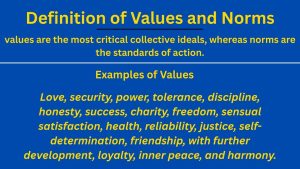
When it comes to values, values are the most critical collective ideals, whereas norms are the standards of action. Extending the scope of values is what standards are.
This is something that the individual learns at a young age to become a complete member of society and to guarantee that it remains cohesive.
Values are defined as “first and foremost what is socially valuable, what we agree on” (Blanquart, 1992).
This definition is also found in the field of philosophy.
Similarly, Château (1985) asserts that “a value is more than a simple motivation; it is a call heard and accepted… a line that we give ourselves, a duty, and a moral instruction.”
These human values are, in particular, respect, acceptance, consideration, appreciation, welcome, openness, mutual aid, reciprocity, solidarity, listening, compassion, empathy, brotherhood, affection and love for other human beings.
What do values and norms have in common
The two are closely related: norms and values. Every standard has a specific value that it is intended to fulfil.
On the other hand, as a sort of guideline for behaviour, each value might be given a particular standard.
“Willingness to help” is a virtue that aligns with the norm “Be helpful!”
The following example demonstrates how the two are related to one another. “Privacy” may be highly valued in a community.
This value offers a broad framework for conduct. Norms establish the practical application of the concept of “privacy” in specific contexts.
Social expectations, as reflected in the attitudes and behaviours of a group of people, are known as cultural norms and values.
While beliefs are sometimes called values, a norm refers to a social group’s everyday attitudes and behaviours. Norms support values.
There is a strong relationship between values and norms since values often serve as the foundation for norms.
Values are the fundamental convictions and concepts that an individual holds dear and considers significant in shaping their lifestyle and professional conduct.
They should establish their priorities and direct their actions and behaviour towards others.
Providing pupils with guidance on norms and values enables them to develop into individuals who contribute positively to society.
Why is it important to have values and norms
Cultural norms and values are essential for maintaining social order and providing us with a feeling of predictability.
At worst, there would be anarchy and turmoil without cultural standards and values.
Cultural norms and values benefit society by providing a framework for acceptable behaviour and thought patterns.
Values reveal what individuals and groups consider significant. Norms specify what must be done for values to be realised.
Rules are meaningless and unjustifiable if they don’t refer to underlying values. In the absence of comparable norms, values are vague and undirected.
People follow social rules because they fear negative social repercussions. People generally avoid problems and abide by the rules as they should, since nobody wants to be the source of societal issues.
Why are norms and values necessary for children
Value refers to the quantifiable worth of anything, which may be determined either in monetary terms or in terms of its importance or meaning.
The significance or use of anything, such as a trait, mindset, or approach, determines its worth.
It is the foundation of every relationship—at work, family, home, and every social situation.
Put differently, norms inform people what is acceptable, but values tell them what is right or wrong.
Values provide cohabitation direction and stability.
Values might include autonomy, mindfulness, integrity, success, justice, hard work, freedom, sustainability, order, punctuality, respect, security, teamwork, dependability, and appreciation.
Values impact our motivation, which leads us to develop and pursue objectives that are consistent with those values. As we achieve our goals, we reinforce our beliefs and increase our drive to seek similar objectives in the future.
They influence the job we perform, the companies we work for, the connections we form, and, eventually, the groups and organisations we lead. Our beliefs impact every decision and action we do, including how we choose to make those decisions!”
Teaching children acceptable values in society helps them grow into the best version of themselves.
What values are there
“Love,” “security,” “power,” “order,” “tolerance,” “discipline,” “honesty,” “success,” “charity,” “freedom,” “sensual satisfaction,” “health,” “reliability,” “justice,” “self-determination,” “friendship,” with “further development,” “loyalty,” “inner peace,” and “harmony”
Integrity, accountability, diligence, persistence, and discipline are the five values most often held and generally recognised.
Here are the five values that are most commonly discussed.
Acquiring and incorporating them into one’s personality over time is possible. They are unique to each culture and remain consistent over time.
It is possible to categorise values in various ways, including individually, collectively, intrinsically, or instrumentally.
Theoretical, economic, artistic, social, political, and religious values are the primary categories included in this categorisation.
Why are norms and values necessary for our society
What are the goals of having norms and values? To a considerable extent, the functioning of a society is determined by the prevalence of particular values and standards.
Norms are the perceived, informal, and generally unwritten regulations that govern acceptable and proper behaviour within a group or society. Social norms exist at the junction of behaviours, beliefs, and expectations.
Norms and values greatly influence social behaviour and interpersonal interactions.
They contribute to social order, encourage collaboration, and improve communication among members of a community.
However, there are situations in which the social order and the behaviours of the community that are being preserved may be damaging and promote unjust power dynamics,
hence contributing to the perpetuation of discrimination as well as social and gender unfairness.
Final thought
Now that we have established the definition of values and norms, some examples of values are tolerance, health, and pleasure. Values are general aims.
The laws and regulations that govern transportation are examples of norms, which are definite guidelines of behaviour.
An example of a norm is a rule of behaviour established by society and adhered to by all individuals. Be courteous, for instance.
Even though it is not a rule, if you do not behave politely towards your professors, you can be subject to sanctions because it is a social standard.
The belief that a person has in anything is referred to as a value.