
- April 23, 2025
- Posted by: Igbaji Chinwendu
- Category: Project Writing Guide
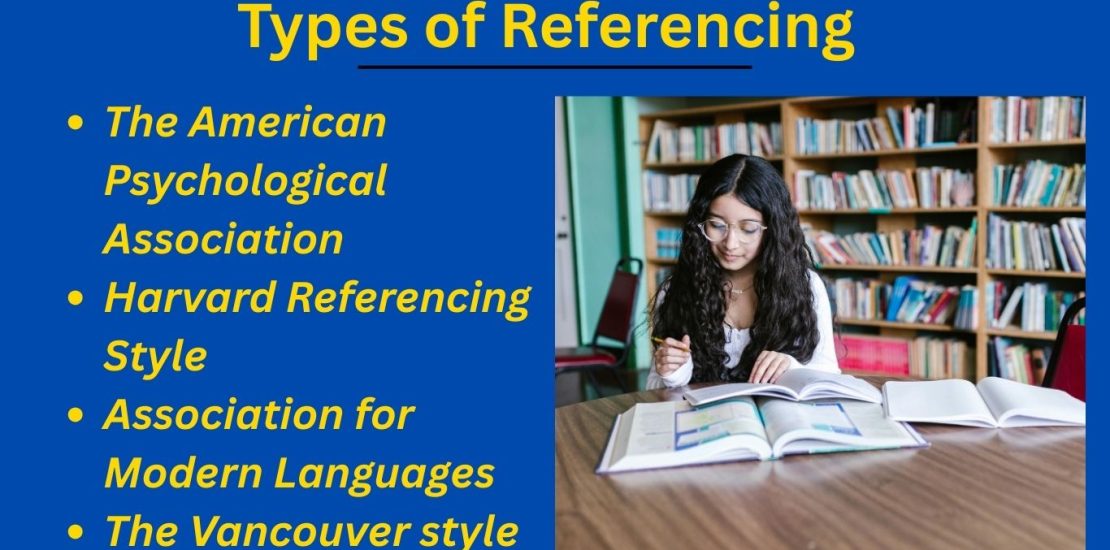
Types of Referencing
Contents
Would you want to know the types of referencing? Based on my experience, Different referencing styles have various rules and guidelines for citing sources properly.
These can be broken down into three main types of systems:
- System with author and date, like Harvard.
- Number system, such as Vancouver.
- A service for keeping notes and citations, like MHRA.
Different academic fields have different referencing styles because they work better with the types of texts that are widely used in those fields.
On this page, there are short descriptions of each kind of referencing used by Reading departments.
Check the course guide every time to see which style they like best.
If you are taking courses at different schools or departments, keep in mind that they may all have their preferred way of citing sources.
That is not all, however. As you read on, I will teach you more about the subject.
Now, let us get started.
What is a Reference
A uniform method for citing sources in the text and reference list is called a referencing style.
Using parentheses to enclose author information and the year of publication (APA style) and numbering references inside the text (IEEE style) are two examples of formatting.
There are standards for how sources should be referenced in every field of study. Social scientists employ parentheses in the text, historians use footnotes, and so on.
Parentheses and footnotes are two areas that have many variants.
Researchers must modify their reference style according to the specific publication or publisher.
However, you must understand the fundamentals of quoting as a student.
The essay concludes with a complete list of references. Additionally, a template is followed when creating the reference list.
Adhere to a consistent format so that, in case of uncertainty, you may consult a list of instances.
The reference styles used for this guide are based on a poll given to faculty members at the Universities of Agder and South-Eastern Norway.
What are the Different Referencing Styles?
References are becoming increasingly important in today’s academic writing, albeit slowly.
To structure their papers and properly mention the data that they contribute to their essays, students must get familiar with a variety of referencing methods.
Thus, the following referring styles are listed:
1. The American Psychological Association (APA)
The field of psychology gave rise to APA as a reference style, which was then utilised to cite and arrange psychology works.
Later, it was embraced globally by several disciplines. One of the original uses of the parenthetical reference style is this one.
Many colleges still use it as the foundation for their reference and online and paper citation instruction. It is a crucial component of academic work.
Scholars have recently emphasised the importance of DOI inclusion following the release of the APA 7th edition.
The paper’s online URL is represented by a series of numbers, characters, and symbols called a DOI, or Digital Object Identifier.
An illustration of APA Hounsell, D. (1984) is cited. Both the preparation and drafting of essays.
Research and Development in Higher Education, 3(1), 13–31.
Additionally, the in-text citation is formatted as follows (Hounsel, 1984).
Note: You must provide et al. following the last name of the first author and a publishing date if there are more than four writers.
2. Harvard Referencing Style
The Harvard style, which is frequently employed in economics, originated at the university’s Department of Zoology in the 1880s.
Subsequently, it became the symbol of all British universities. It also fits within the technique of parenthetical reference.
These days, practically every university has its own style for adding references, including where to put the bracket, comma, full stop, and date.
While there is not one accepted method for explaining how to reference sources at Harvard, the following is a typical example of one:
D. Hounsell (1984). 13–31 in Higher Education Research and Development, volume 3, number 1. Essay drafting and preparation.
You must write when citing sources in-text (Hounsel, 1984).
It should be noted that each university has a different comma following the last name.
Additionally, if there are more than three writers, you have to insert the first author and the publishing date after the last name of the first author, followed by et al.
3. Association for Modern Languages (MLA)
One of the recognised reference formats used by humanities disciplines worldwide, particularly in the fields of literature and history, is MLA.
Professors of language and literature use the citation style because it is consistent and has fewer grammatical errors.
For this reason, MLA is the recommended option in many humanities classes.
There is still a manual for MLA format that covers several language papers.
Furthermore, because of its parenthetical reference style, it is frequently taken into consideration as an alternative to the APA format.
The work “Essay planning and essay writing” by Hounsell, Dai, is an example of MLA work referenced. Research and Development in Higher Education 3.1 (1984): 13–31.
MLA citation inside the text: Hounsell, 29.
Note: doi is required in the 9th edition of MLA format. It is crucial. Additionally, in MLA in-citations, the page number might come after the final name.
Additionally, you must follow the last name of the first author with the other writers’ first names if there is more than one.
4. The Vancouver Style of Referencing
The Vancouver style falls under the referencing style’s numbering form. It started in Canada, appropriately enough, when editors of medical journals got together to figure out what might be done to help biomedical students.
Additionally, they lack a set style guide, just like Harvard. Universities and other organisations are free to establish their policies.
1. Hounsell D. Essay preparation and writing. Higher Education Research and Development. 1984 Jan 1;3(1):13-31. This is an illustration of the Vancouver referencing style.
What to Use for Referencing
Your choice of reference is primarily determined by the topic or academic field you are studying.
It is essential to verify with the professor or teacher before submitting your work, as some demand that students use a certain referencing style.
You may also find out the appropriate referencing style for your subject by consulting the course manual.
Check with the publisher whether they require citations in a certain format for manuscripts.
If you are free to select your style, use caution because some styles work better for particular subjects than others.
For instance, the EU Journal of Criminology uses the Harvard citation format, whereas the Journals of Marketing and Management follow the APA style.
The MLA style is used in the humanities, the Chicago/Turabian style is used in business, history, and the fine arts, and so on.
You should be able to select the appropriate reference style for your work by using the list below.
If in doubt, find out from your lecturer which referencing style is needed for your course.
What are the Major types of referencing styles used in academics
There are many various kinds of reference styles, as was previously discussed, but you only need to utilise the ones that are accepted by publications and academic institutions.
We have given you a few essential ones in this blog that are necessary for academics:
MLA citing style:
As implied by the name, the Modern Language Association developed the MLA referencing style.
It is currently in its eighth edition. The majority of scholars who study language and literature employ this technique.
The parenthetical citation style, which includes the page number and the name of the author, is widely used.
The APA reference style was developed by the American Psychological Association and was initially used in social science and psychology studies.
Nonetheless, this work is widely utilised by several researchers in other fields. It is currently in its seventh edition.
An author-date parenthetical referencing system is frequently used in this kind of referencing style.
Chicago referencing style: This form of reference was created by the Chicago Manual of Style. Additionally, it is available in Chicago A and Chicago B, its two variant forms.
The researcher is able to credit sources in an endnote or footnote using Chicago A. Chicago B, on the other hand, uses parenthetical author-date referencing within the text.
Turabian style of referencing:
The Chicago style of reference served as the model for the Turabian approach. It is intended especially to force pupils to work on a research article.
Turabian style references have two types: an author-date system and a documentary note system, which function similarly to the Chicago style.
Harvard’s way of referring
In the discipline of economics, this method of reference is typically employed. Although there is no formal handbook for it, several groups have their own format for citing works by Harvard.
Several well-known ones use an author-date system, such as the Australian Government Publishing Service (AGPS), British Standards Institution, and certain Harvard editions.
What are the five major types of reference sources
Frequently, reference materials must be perused in their entirety; instead, they are consulted for specific information.
The reference categories that are most frequently used are:
- Yearbooks and Handbooks
- Encyclopedias and dictionaries
- Almanacs and Directions
- Catalogues and encyclopedias
For a minute, let’s look at each of these types of reference materials.
Dictionary, Atlas, Almanack, and Encyclopedia:
Typical Dictionaries and Atlas Types
Words and phrases are defined in dictionaries. You could check the terms “peregrination” and “Le Mer” using one or more of the following dictionaries if your lecturer did not explain them to you.
General: covers all topics; abridged: shorter, might not cover all word meanings, might not contain more esoteric terms; or unabridged: includes all subjects.
Etymological: Follow the word’s origins.
Foreign Language: Convert foreign terms into English, such as “The Sea” (Le Mer).
Desk: Get rid of old jargon and highlight how words are pronounced and understood nowadays.
Under Slang & Dialect, there are definitions for slang phrases like “y’all” and “possum.”
Lexicons contain both synonyms and antonyms.
Provide the whole names or shortened forms of the titles of organisations and groupings.
A quotation is a rewording of a well-known essay, speech, or phrase.
Yearbooks, Handbooks, Manuals, and Biographical Sources:
Manuals, etc.
Manuals, often called handbooks, are helpful reference materials that frequently contain examples, drawings, or both.
As an illustration:
The MLA Handbook for Research Paper Writers (Reference: LB2369.G53)
The APA Publication Manual (REF BF76.7.P83) and the CRC Handbook of Chemistry and Physics (REF QD65.H3)
PDR – Reference for Physicians’ Desk: RS75. P5.
Online Resources for Reference:
Online Reference Collections: Their Character
Most people are familiar with reference books from libraries, which are referred to as “books that can’t be checked out.”
However, what happens if you locate them online? Do they still serve as references?
An Excellent Online Reference Source needs to:
contains current data that is updated often.
Be highly sought after.
Owns an excellent reputation.
How do you recognise different referencing styles
This is an illustration of an author-date in-text citation:
Some themes come to light in Knapik et al. (2015)’s review of the literature.
When a source is used in this way, the date and author are located and identified inside the text. This enables the reader to obtain the full citation to the source on an independent list of references (also known as a bibliography) at the end of the article.
This is an illustration of a notes and bibliography style in-text citation:
A few themes come through in their literature review (1).
This style makes use of endnotes or footnotes, where all the citation information is provided in the endnotes (found at the conclusion of the essay) or the footnote (found at the bottom of the current page).
A condensed version of the reference is used in the footnote or endnote if it appears more than once.
The complete list of references, commonly known as a bibliography, is included in a separate list at the conclusion of the article.
Final thought
Now that we have established the Types of referencing, it is also important to know that Referencing helps readers to verify references as soon as possible, follow up on the issue addressed and read more, demonstrate that the author is not plagiarising, and recognise and provide credit to sources.