
- April 28, 2025
- Posted by: Igbaji Chinwendu
- Category: Project Writing Guide

Components Of A Feasibility Report
Contents
- 1 Components Of A Feasibility Report
- 1.1 What Are The Five Components of a Feasibility Report
- 1.2 What are The Contents of a Feasibility Report
- 1.3 What Are The Points Included in a Feasibility Report
- 1.4 What Are The Seven Objectives of a Feasibility Report
- 1.5 How To Make a Feasibility Report
- 1.6 What Is The Structure of a Feasibility Report
- 1.7 Final thought
Would you want to know about the components of a feasibility report? Based on my experience in this industry, I would say that a feasibility report consists of five essential elements: economic, marketing, technological, financial, and managerial viability.
Every type of study considers distinct aspects of the project; consequently, it is essential to consider all five while deciding which path to pursue further.
Starting a large-scale, complex project with a significant impact on your company might be interesting. You are effecting real change here. One might get enormous horror in failing.
This post will get you started if you have never done a feasibility report before today.
Now, let’s get started
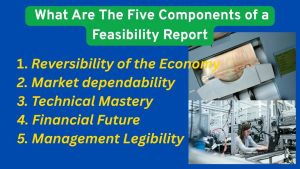
What Are The Five Components of a Feasibility Report
The five varieties of feasibility studies include scheduling feasibility, operational feasibility, legal feasibility, economic feasibility, and technological feasibility.
1. Reversibility of the Economy
Analysing if all the required inputs and contracts are in place for the firm to be operational and whether the resulting benefits and impacts are notable allows one to ascertain economic feasibility—a cost-benefit analysis.
Factors August Brown looks at in Economic Feasibility:
- The lowest minimal input (labour, infrastructure, utilities, renewable resources, feedstocks) is needed to run economically.
- Both are in place and are the ones to be arranged, keeping terms and renewals in mind.
Environmental threats. - The general economic impact of the project covers the economic development and newly developed markets.
- Project cost concerning rising income or benefits supplied.
2. Market dependability
Any group of individuals or businesses has to give significant thought to market viability.
It highlights the competitiveness, the existing and future market prospects of the organisation, and the target customers of a project.
3. Technical Mastery
Technical feasibility investigates the dependability of the technology to be applied, as well as the study of the supply of products or services, including transportation, company location, and demand for technology, materials, and labour.
4. Financial Future
Financial feasibility studies expose the elements needed to meet all debt obligations and guarantee the economic sustainability of a project using suitable income, credit, and cash flow over the long term.
5. Management Legibility
Looking at the company’s or organisation’s ownership, board, background, credentials, and required capacity or knowledge to implement the project, management feasibility studies
What are The Contents of a Feasibility Report
A comprehensive analysis of the requirements that must be met to finish the planned project is included in a feasibility report.
The report may contain a description of the new product or business, a study of the market, the necessary technology and labour, and the sources of funding and cash.
What Are The Points Included in a Feasibility Report
A feasibility study provides an objective assessment looking at all aspects of a suggested project, including technical, financial, legal, environmental, and technological considerations.
This data then enables the decision-makers to determine whether or not to forward the project.
A feasibility study is made up fundamentally of these elements: an executive summary offering a general picture of the project’s overall viability.
A description of the good or service under production meant to satisfy project needs, technical in nature considerations, including those related to technology, tools, or staff.
What Are The Seven Objectives of a Feasibility Report
Regardless of the type of project—starting a new company, launching a new product into the market, developing a project, planning an architectural project, etc.—the objectives of a feasibility study are several.
Determine what requirements and efforts are required to ensure the success of the project; • Project the risks and constraints it will face;
Choose which tools to coordinate. Find the needed ROI and budget to assess profitability; Analyse possible results and maximise their benefits.
Provide several teams and interested parties access to the criteria and phases of completion; Make sure the project will finally succeed in its objectives.
This study offers a complete analysis of the technical and organisational feasibility of a project; most crucially, it shows its financial viability.
Actually, should you discover at this time that the project is not lucrative, modify the objectives and scope of the project or perhaps abandon it.
How To Make a Feasibility Report
A feasibility report calls for seven stages.
1. Perform a first investigation.
Allow us to start with a brief review and analysis. This stage begins before the formal commencement of your feasibility study.
Your knowledge will help you prepare the first part of your feasibility study. In this stage, you must lay out your intentions and any possible obstacles.
2. Specify the project’s parameters.
Your project references the scope multiple times but includes specifics exclusive to your feasibility study.
This will act as the compass for your project, defining criteria you could evaluate and test during the feasibility study.
Already, you are outlining your approach and the difficulties you encounter. This knowledge will help you to define your scope and probe below.
3. Examining the market
Using market research, you might discover more about your business surroundings and the possible influence of outside factors on your project.
This part of the study further details market fit, rivals, demand, and product interest. Without them, projects risk being ill-targeted or based on false market conditions and desires.
Make sure your market research covers these points:
• Demand and volume: The market’s demand for your product might affect your ability to predict production capacity or resources you will need, direct your distribution choices, and sell it with ease.
• Demographics: Although the decision to purchase the goods was taken in concert, the decision maker’s profile might be necessary for your study.
When creating, planning, and marketing your product, knowledge of career, educational level, and other personal characteristics might be helpful.
(Tip: Arrange this demographic data using the user persona template.)
4. Review financial records.
The heart of your project consists of its financial and operational aspects. Any project requires resources; hence, you will most likely have to budget, plan, coordinate your effort, and make certain judgments.
These are some techniques to review this critical material.
5. Identify potential obstacles and consider possible solutions.
How might things go wrong? Your project needs to succeed, so you must anticipate issues and respond promptly to provide solutions.
Though it’s best to start this research process before your project begins, your team may still find a sensible approach to go beyond any obstacle that develops.
6. Review the results of the feasibility study.
At this stage, you will review your results to ensure they match your expertise and research as much as possible.
Check your computations to be sure your financial analysis is complete.
Once you have reviewed your data, go back over your study. Review your findings and prepare for choice decisions.
7. Get a clear ending.
Your staff should be aware of the viability and value of the project.
Consider the objectives your project will achieve should it be successful when you review your outcomes.
Does the expenditure of money, time, and resources justify the likely return on investment? Are there maybe too strong obstacles to go beyond?
Can your group recover from either possible or expected losses? Do the risks warrant the benefits?
When deciding, take a broad view, combine your assessments, and share your findings with your team.
What Is The Structure of a Feasibility Report
Examining a proposed solution given particular constraints, a feasibility study evaluates its viability.
The first six sections are the introduction, background information, requirements, evaluation, results, and proposal or final opinion segment.
Furthermore, a feasibility study has to look at the sustainability of structures and policies (using indicators) and offer future forecasts depending on acknowledged uncertainty.
Whether you are extending a property upward or outward, altering the layout, moving buildings like stairways and balustrades, or adding a mezzanine,
A structural feasibility report will help you proceed with your project, knowing that all the implications have been identified and any risks have been reduced.
Final thought
Now that we have established the components of a feasibility report, it is among the most crucial parts of the project’s starting phase.
A feasibility study is carried out to ascertain whether or not a developed project idea will be feasible.
It assesses the technical features, feasibility, and relevance of the project to the business, as well as the effectiveness of all costs connected to it.
Furthermore, the objective of a feasibility study is to assist in that decision by providing the management team or owners of the firm with the best facts on the matter.
Based on the most current data on organisational and financial control, areas of weakness, and other market developments, the management determines whether or not to forward the company.